
The Pagoda Broke. The Trust Did Not.
Anyone can be honest when honesty is free.

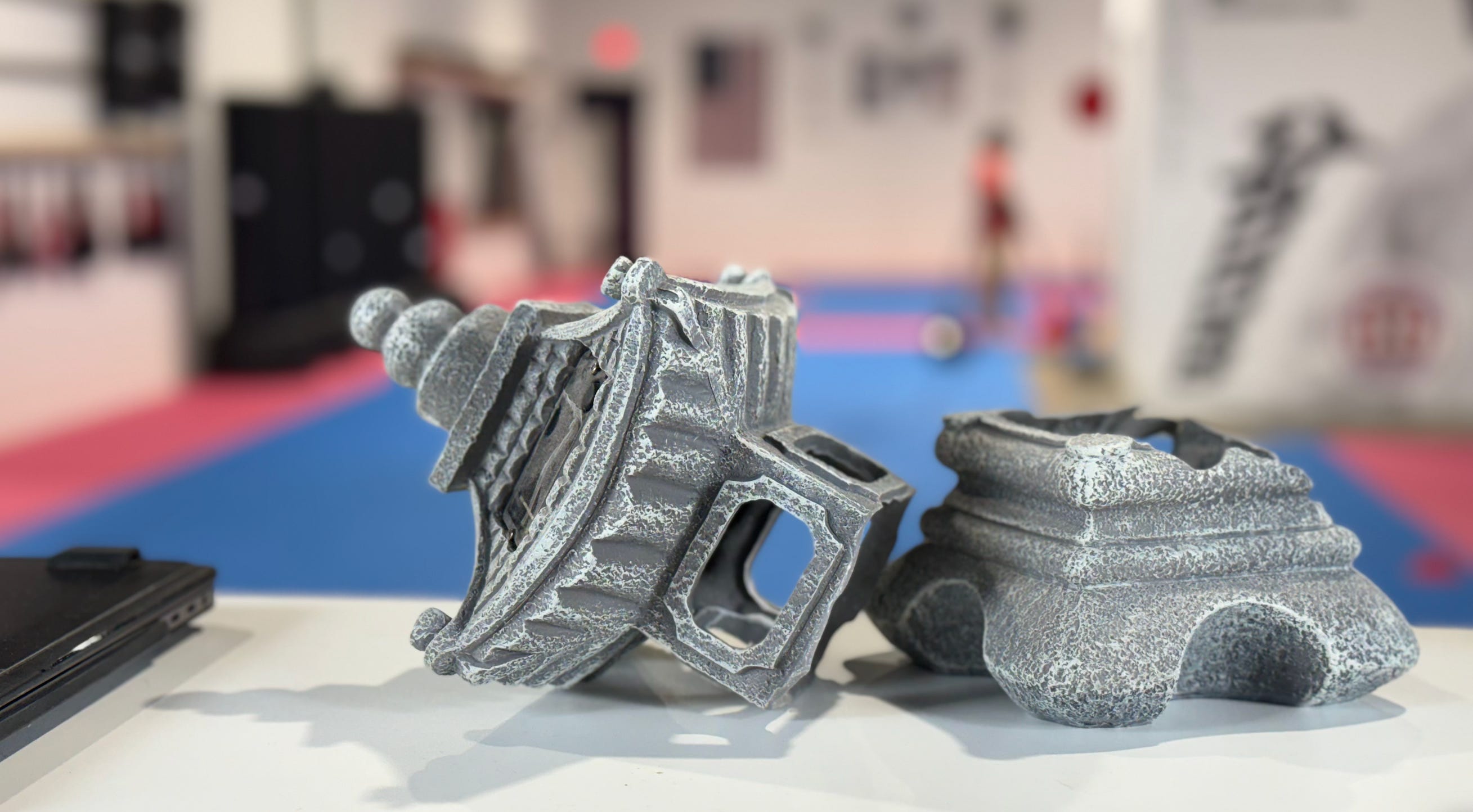
After our first training session of summer camp, I found a small gray chip on the floor of the dojo. I did not know what it was at first. Then I looked up at the floating shelf on our shomen wall and my stomach dropped a little. The little stone pagoda that has watched over every class we have ever held was gone.
Only two students came to camp that day. I asked them what happened. Both said they did not know. I told them, “Guys, this thing did not grow legs and walk out of here.” Still nothing. So I went to the box where we keep our shin guards, and there it was, buried under the equipment, broken in two pieces. I fished it out and held it up. They said they did not know how it got there. And then the speculating started. Earlier that day, one of the dads had come by during lunch to pick up his son, and he had used the restroom while he was there. The other student, genuinely trying to solve the mystery, wondered out loud if maybe the dad had knocked it over on his way through. He was speculating honestly. He had no idea what happened, so every theory was fair game to him. But the other one knew. So I turned to the son and asked him straight: “You think he is right? You think it might have been your dad?” He shrugged his shoulders. A shrug. “So now we are going to blame your dad? I am going to have to ask your dad? We are going to start dragging other people into this?” That is how far a lie will carry you once you let it start walking. It had already grown past the room, and given the choice between owning a broken ornament and letting suspicion fall on his own father, the lie was ready to pick his father.
I am not going to write the cleaned-up version of this story, the one where the wise sensei stays perfectly calm and speaks in a soft voice. I got angry, and the anger grew the longer they held out. Not because of the pagoda. It is a decoration. It can be glued. I was angry for two reasons. First, they were insulting my intelligence. There were three people in that room, the thing was hidden under our shin guards, and they were looking me in the eye telling me nobody knew anything. And second, they were willing to throw away the trust we have built in this dojo just to stay out of trouble, like it was worth nothing. That is a much bigger crack than the one in the stone.
So I told them this was no longer about the pagoda. And then I told them a story about myself, because I have been exactly where they were standing. When I was six or seven years old, my mom set up a nativity scene under the Christmas tree, like every Mexican household does. One day I was playing ghost with a blanket over my head, which is about as safe as it sounds, and I knocked over one of the three magi. The head broke clean off. And what did I do? Did I go find my mom and own it? Of course not. I grabbed the head and threw it on top of the refrigerator like I was disposing of evidence. My mom knew it was me. She did not even have to ask. And I paid for it.
I told my students that I understood the instinct to cover yourself. It is human. Every kid has it, and plenty of adults never grow out of it. But I also told them what it would cost. A broken ornament costs nothing. Broken trust costs everything we are trying to build in this dojo. I asked them to put themselves in my shoes. How would they handle it? Would they feel good about it? Nothing. I gave them out after out, and they would not take a single one. The room got very quiet. We were past the point where this could end easily, and all three of us knew it. So I finally turned to one of them and said the thing out loud: “I think it was you.” And then I told him, “I am not trying to coerce an answer out of you. If it is the truth, say it is the truth. If it is not, stick to it.” I did not want a confession. I wanted the truth, and those are not the same thing.
Then, finally, he did the hardest thing I have asked of any student all year. With tears in his eyes, he told me the truth. Not on the first ask. Not on the second. He told the truth after holding the lie four or five times, in front of his training partner, with his sensei standing right there holding the evidence. And I will tell you something I believe with my whole chest: it is easier to break a board than it is to take back a lie. Anyone can be honest when honesty is free. He chose it when it was expensive.
I thanked him, and I am not too proud to admit that I choked up doing it. He was holding back tears and so was I. All that pressure left the room at once, for both of us. I told him I respected what he just did more than any kata he could perform for me, because reversing course in the middle of a lie takes a kind of courage we do not hand out belts for, but probably should.
This is what we mean when we say karate is not an activity. Nobody signed up for summer camp expecting a lesson in owning your mistakes. But the dojo has a way of putting a mirror in front of you when you least expect it, and what you do in that moment is the real training. The kicks and punches are just the part you can see.
The pagoda is going back on the shelf, glued together, crack and all. I want my students to see it every time they bow in. Things break in here. People miss, people fall, people fail, and once in a while somebody tells a lie they wish they could take back. None of that is the end of anything. What matters is what you do after.
Because the pagoda broke in two that day. The trust did not. We glued both back together, and only one of them came out stronger.
Kenji Nakata is the owner and head instructor of Nakata Dojo, a traditional Shito-Ryu karate school in Urbandale, Iowa, serving families across the Des Moines metro. He is a member of Shito Kai Murayama International and teaches karate the way it was passed down to him: as real life education, not an after-school activity. Kids ages 4 to 15 start in the Foundations program, a 4-week beginner cycle capped at six students so every child gets real instruction. New cycles start every month. If you are the kind of parent who is careful and intentional about what you put in front of your kids, learn more about karate classes at Nakata Dojo in Urbandale at nakatadojo.com.