
Kime: The Shortest Path to School
How Karate-Do turns frustration and repetition into strength, patience, and real learning

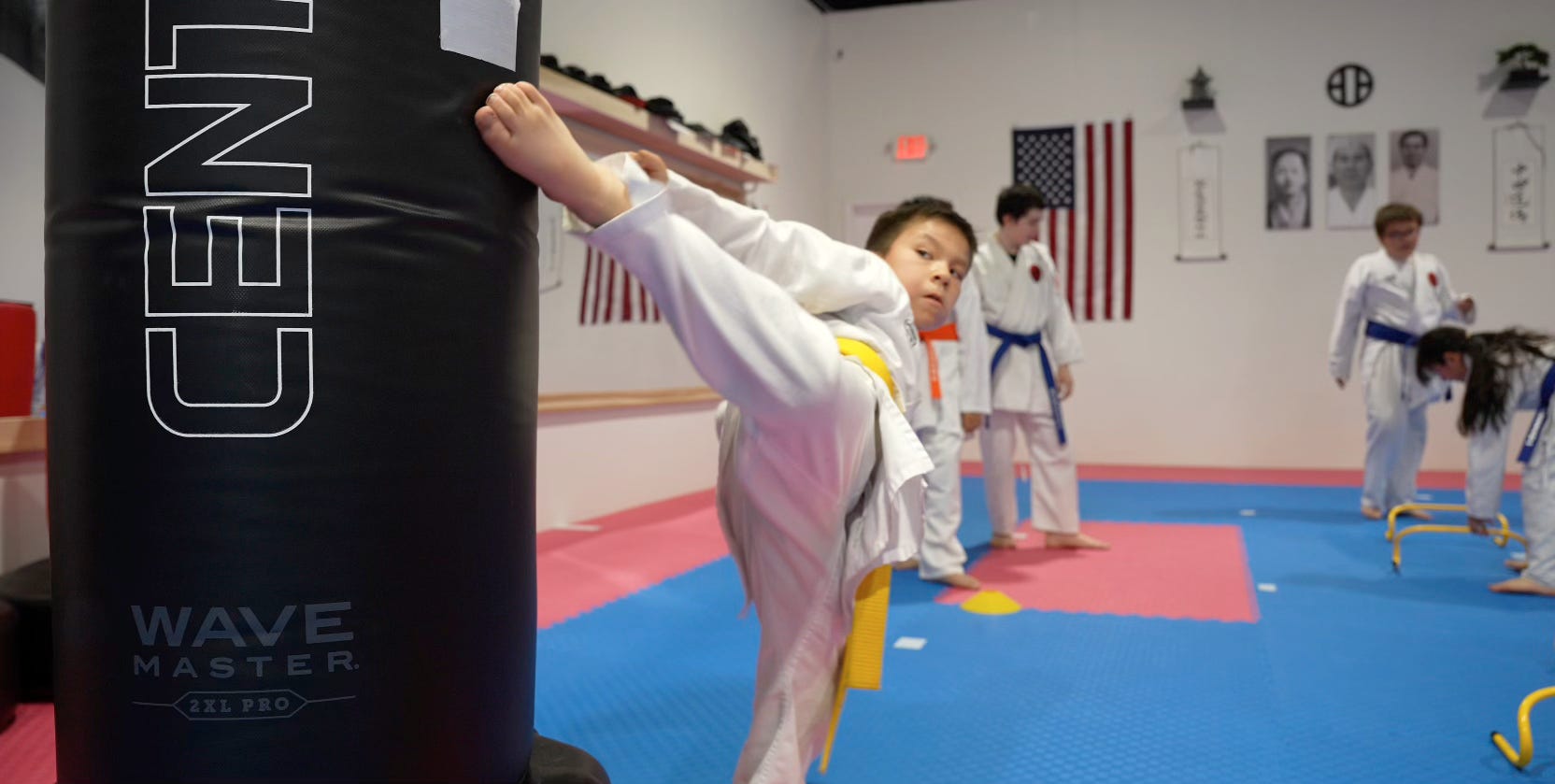
I know what you’re gonna say. “Oh no, here comes Kenji talking about Karate” But hear me out. I know a lot of people that I associate with don’t really care about Karate. They think it’s a little strange that a grown man is super into it. But Karate-Do is more than just an activity you may have explored growing up. I am writing here so I can educate especially those who have known me for years. Some of you still can’t believe that I teach Karate because I don’t fit the profile. But when you read this whole thing, hopefully, it will make sense.
Karate-Do is hard. And that is exactly why it is worth doing.
From the outside, it might look simple. People see the punching, the kicking, the blocking, and the repeating of drills. But once you are the one wearing the gi and bowing into the dojo, you quickly realize there is much more to it. Every stance has a reason. Every strike has a detail that can change everything. Breathing, hips, pulling hand, balance, rhythm. Karate-Do is about precision, and precision means paying attention to things that are often invisible to beginners.
That is where most students struggle.
Children especially do not yet understand how they actually learn. To them, everything feels the same. They might throw ten punches and believe all ten looked identical. But to someone who knows, nine were off balance and only one had the right connection. They get frustrated because they cannot see the difference. They do not yet know that learning is about repeating until the difference becomes obvious.
And to be fair, this challenge is not only for children. Many adults also have a disconnect in their bodies. They might think they are coordinated, especially if they played sports growing up, but Karate quickly humbles even athletes. Movements that seem simple at first reveal a level of detail that exposes gaps in balance, timing, and body awareness. That moment of humility is not failure. It is often the moment when real learning begins.
Part of our job as instructors is to build that bridge for both children and adults. We have to find ways to make the invisible visible. Sometimes that means telling stories. Sometimes it means drawing pictures. Sometimes it even means teaching new vocabulary so students can have the language to describe what they are seeing. In fact, many of my students learn new English words right here at the dojo, not just Japanese terminology.
Yesterday I built the entire day around one word: efficiency. I drew a map on the board with a set of city blocks. On one corner I drew a little house. A few blocks away I drew a school. Then I asked them, “What is the best way to walk to school?” Without hesitation, they traced the quickest path. Then I took the marker and drew the longest way around the block. I told them my way was better.
You should have seen their reaction. They objected immediately. They argued with passion, telling me that my route was slower and wasteful. They said I would be late, that I would miss class, that it made no sense to go the long way when a straight path was right there. And of course, I did not just let it go. I gave them my usual annoying comebacks, pretending to defend my choice and pushing them until they were practically shouting at me. That was exactly what I wanted. When they get riled up like that, it shows me they are engaged, thinking hard, and paying attention.
That was when I revealed the lesson. I told them that Karate is the same. In Karate you can still arrive at the target with a clumsy punch or a stiff kick. But the true way, the efficient way, is to connect all the details. Breathing. Hips. Pulling hand. Stance. Timing. When these elements come together, the technique is not only sharper and stronger, but it also costs less energy. The body moves as one, so instead of exhausting yourself, you generate maximum results with minimum effort. That is the essence of kime.
But here is another truth: children resist. They love games, variety, and constant entertainment. Gamification has its place, but when it is overdone the repetition that builds skill can get watered down. Sometimes fun takes the front seat, and progress takes the back seat. The hardest part is helping them see that focused, intentional repetition is the real engine of improvement.
I know this because I live through the same frustrations myself. I never try to be the mystical sensei who is perfect and cannot do anything wrong. The truth is, I am still a student, and often a bad one. I have a strange pace of learning. I make a lot of mistakes, and I usually have to learn alone. I was the kind of student who frustrated teachers because I could not get things right on the first try. In many ways, I still learn almost exclusively from mistakes.
That is why I connect so strongly with my students. When they are frustrated, I understand it. When they keep missing the detail I am asking for, I have been there. When they want to give up, I know exactly how that feels. And because I know that path so well, I can guide them through it. I can show them the lessons I had to learn the hard way, so they do not have to waste the same time. My role is not to stand above them, but to walk beside them and remind them that the hard road is still worth it.
This is where Karate-Do becomes truly hard. Not just because of the technical details, but because we must convince students that repeating something one hundred times is not punishment. It is the path to mastery. The truth is that repetition can be boring. But through it, frustration slowly turns into skill. Confusion turns into clarity. The student begins to see and feel the difference for themselves.
That is when their eyes light up. That is when they understand that what once seemed impossible has now become natural. The same punch that once felt clumsy now feels sharp. The same kata that once looked like random steps now flows like a story. The same child who once thought they could not learn begins to realize that they can. The same adult who once thought they were coordinated begins to discover they still have much to learn.
Karate-Do is supposed to be hard. That is what makes it good. It is in the struggle that children and adults discover their own strength. It is in the repetition that they learn patience and discipline. And it is in the details that they uncover the real meaning of Karate-Do: that small, intentional efforts lead to less effort and maximum results. That is kime.